Construction Contract Management Software: A Strategic Guide for 2026
Mastering Multi-Contract Ecosystems from Tender to Execution
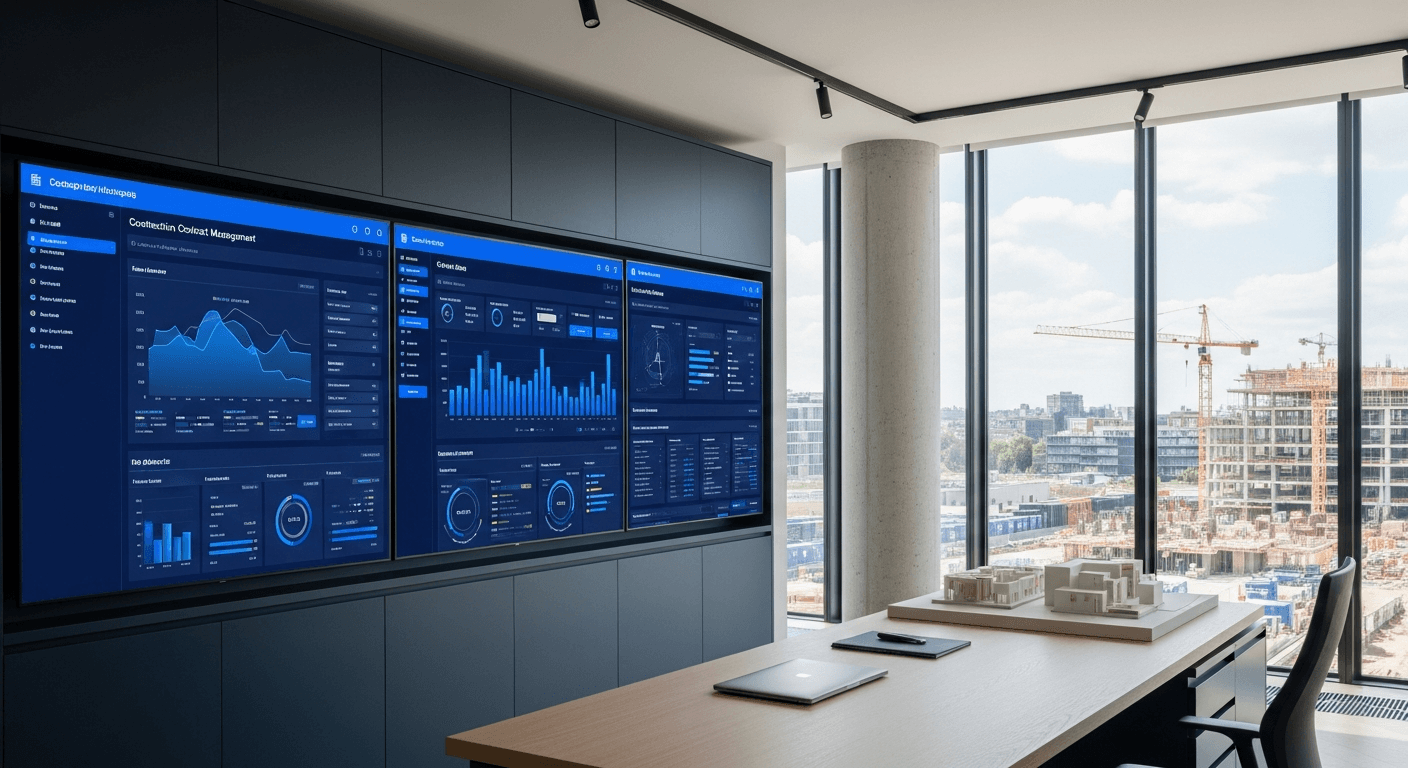
Managing complex infrastructure and building projects requires more than just a digital filing cabinet. In 2026, the industry is shifting toward integrated contract operating systems that align general contractors and subcontractors in real-time.
Key Takeaways
- Construction contracts are ecosystems, not isolated documents; alignment between GC and subcontractors is critical.
- The transition from tender to execution is a high-risk phase where information loss frequently leads to cost overruns.
- AI should be used as a high-speed assistant for risk detection and clause analysis, supporting rather than replacing human experts.
- Generic CLM tools lack the construction-specific logic required to manage VOB, FIDIC, etc.
Introduction
For general contractors and project developers managing portfolios between €100M and €5B, the contract is not just a legal document—it is the operational blueprint of the project. However, traditional methods relying on fragmented Excel trackers and static PDFs often lead to 'contractual drift,' where the reality on the construction site no longer matches the legal obligations signed months prior.
At Arctis AI, we recognize that the construction industry faces unique challenges that generic Contract Lifecycle Management (CLM) tools cannot solve. From managing VOB and FIDIC standards to ensuring back-to-back alignment across dozens of subcontractors, modern construction contract management software must act as a living ecosystem that protects margins and mitigates risks throughout the entire project lifecycle.
Why Generic CLM Fails the Construction Industry
Most contract management tools on the market today were built for procurement or HR departments. They excel at simple, linear workflows like NDAs or software licenses. However, a €500M infrastructure project is anything but linear. It involves a complex web of dependencies, where a delay in a single subcontractor's delivery can trigger liquidated damages across the entire project chain.
Generic CLMs lack the depth to handle multi-contract project ecosystems. They treat every contract as an isolated island. In contrast, we built Arctis AI to understand the relationship between the main contract (GC) and the various subcontractor (NU) agreements. If a clause in the main contract changes regarding site access or payment terms, that change must be reflected or accounted for in every downstream agreement. Generic tools simply cannot provide this level of back-to-back alignment, leaving firms exposed to significant legal and financial gaps.
The Multi-Contract Project Ecosystem
In modern construction, a project is only as strong as its weakest contractual link. We view every project as an ecosystem of interconnected agreements. This includes the main contract with the owner, dozens of subcontractor agreements, and hundreds of supplier contracts. Managing these in silos is a recipe for disaster.
- Visibility: Real-time oversight of all contract tiers.
- Dependency Tracking: Understanding how a variation in one contract affects others.
- Compliance: Ensuring all subcontractors meet the same safety and quality standards mandated by the client.
By digitizing these relationships, we allow project teams to see the 'big picture.' For example, if the main contract specifies a 5-year warranty period, our platform flags any subcontractor agreement that only offers a 2-year warranty, preventing a 3-year liability gap for the general contractor.
Tender to Execution: Closing the Information Gap
One of the most common points of failure in construction is the handoff between the tender team and the project execution team. According to a 2025 McKinsey report on construction productivity, information loss during project transitions is a primary driver of cost overruns. Risks identified during the bidding phase—such as specific soil conditions or local regulatory hurdles—often vanish into a drawer once the contract is signed.
We solve this by maintaining a continuous thread of data from tender to execution. The risks, assumptions, and deviations identified during the negotiation phase remain visible to the project managers on-site. This ensures that the team executing the work is fully aware of the contractual boundaries and 'red flags' that were negotiated by the legal and procurement teams months earlier.
Post-Signature Operations: The Real Value Driver
This is the phase where obligations must be met, deadlines tracked, and variations managed. In a typical VOB or FIDIC contract, missing a notice period for a claim can result in the total loss of that claim's value.
Our platform acts as a proactive monitor for these obligations. Instead of waiting for a human to check a calendar, we provide continuous monitoring of:
- Payment Mechanisms: Ensuring milestones are met before invoices are processed.
- Warranty Deadlines: Tracking the expiration of performance bonds and maintenance periods.
- Notice Periods: Alerting teams to critical windows for submitting variation orders or delay notices.
AI as an Assistant, Not a Replacement
There is a lot of hype surrounding AI in the legal sector, with some claiming it will replace lawyers entirely. We take a different view. In the high-stakes world of construction, human judgment is irreplaceable. Our AI is designed to be a powerful assistant that augments the capabilities of contract managers and legal counsel.
By automating the tedious parts of contract review—such as identifying standard VOB clauses or searching for specific indemnity terms—we reduce manual review time by up to 70%. This allows your experts to spend their time on strategic decision-making and complex problem-solving. We provide the data and the alerts; your team provides the expertise and the final word.
Key Features to Look for in 2026
When evaluating construction contract management software, look for features that address the specific realities of the job site. A generic 'search' function is not enough. You need intelligent search that understands construction terminology and can find related clauses across multiple project files.
| Feature | Why it Matters |
|---|---|
| Multi-Tier Visibility | See the link between GC and Subcontractor obligations. |
| VOB/FIDIC Support | Pre-built logic for industry-standard contract forms. |
| Obligation Tracking | Automated alerts for deadlines and milestones. |
| Risk Heatmaps | Visual representation of contractual risk across a portfolio. |
The ROI of Digital Contract Management
The financial impact of poor contract management is staggering. Industry data suggests that 10–15% of project value can be lost due to unmanaged variations and missed claims. For a €200M project, that is €20M–€30M at risk. By implementing a dedicated contract operating system, firms can significantly reduce this 'leakage.'
Beyond direct cost savings, the ROI is found in risk avoidance. Preventing a single major dispute or avoiding a liquidated damages claim can pay for the software many times over. Furthermore, the efficiency gains—moving from weeks to days for contract turnarounds—allows your team to take on more projects without increasing headcount.
Implementing a Contract Operating System
Transitioning from Excel and folders to a structured platform like Arctis AI is a strategic move. It requires a shift in mindset from 'storing documents' to 'managing data.' We recommend a phased approach: start by digitizing the main contracts of your most complex projects, then expand to subcontractor alignment and post-signature tracking.
Our team works closely with you to ensure the platform reflects your specific workflows and risk appetite. Because we are built specifically for construction, the implementation process is much faster than with generic tools that require months of custom coding to understand a simple construction variation order.
Conclusion: The Future of Construction Contracts
The construction industry is becoming more complex, not less. Regulatory requirements are increasing, margins are tightening, and project structures are becoming more fragmented. In this environment, the contract is your most powerful tool for maintaining control. By moving to a dedicated construction contract management platform, you aren't just digitizing paper—you are building a foundation for more profitable, less risky projects.
At Arctis AI, we are committed to providing the infrastructure for this digital transformation. Better projects truly do begin with better contracts.
Generic CLM vs. Arctis AI for Construction
| Feature | Generic CLM (e.g., DocuSign) | Arctis AI |
|---|---|---|
| Project Ecosystems | Single contract focus | Multi-contract alignment (GC to Sub) |
| Industry Standards | Generic templates | Built-in VOB/FIDIC logic |
| Risk Detection | Basic keyword search | AI-powered construction risk analysis |
| Lifecycle Coverage | Mostly pre-signature | Full Tender-to-Execution lifecycle |
| Post-Signature | Basic storage | Active obligation & warranty tracking |